
Karen Kissinger Coaching – tai chi for beginners can look almost too gentle to count as exercise until you try holding your posture, shifting your full weight onto one leg, and moving the other foot without losing your center. That quiet challenge is exactly why I keep coming back to tai chi in holistic wellness work: it asks for strength, attention, breathing, and coordination without demanding that your joints absorb the pounding of a high-impact workout.
⚡ Quick Answer
Tai chi for beginners is a low-impact mind-body practice built around slow movements, controlled breathing, posture, and deliberate weight shifting. For adults over 50, it can train balance, mobility, leg strength, and body awareness. A major research review found tai chi may reduce the number of older adults who fall by about 20%.
What Is Tai Chi, and Why Does It Work So Well for Beginners Over 50?
Tai chi grew from a Chinese martial art, but the health-focused practice most beginners encounter today combines slow, gentle movement, physical postures, controlled breathing, and focused attention. The National Center for Complementary and Integrative Health describes those elements as central to the practice.
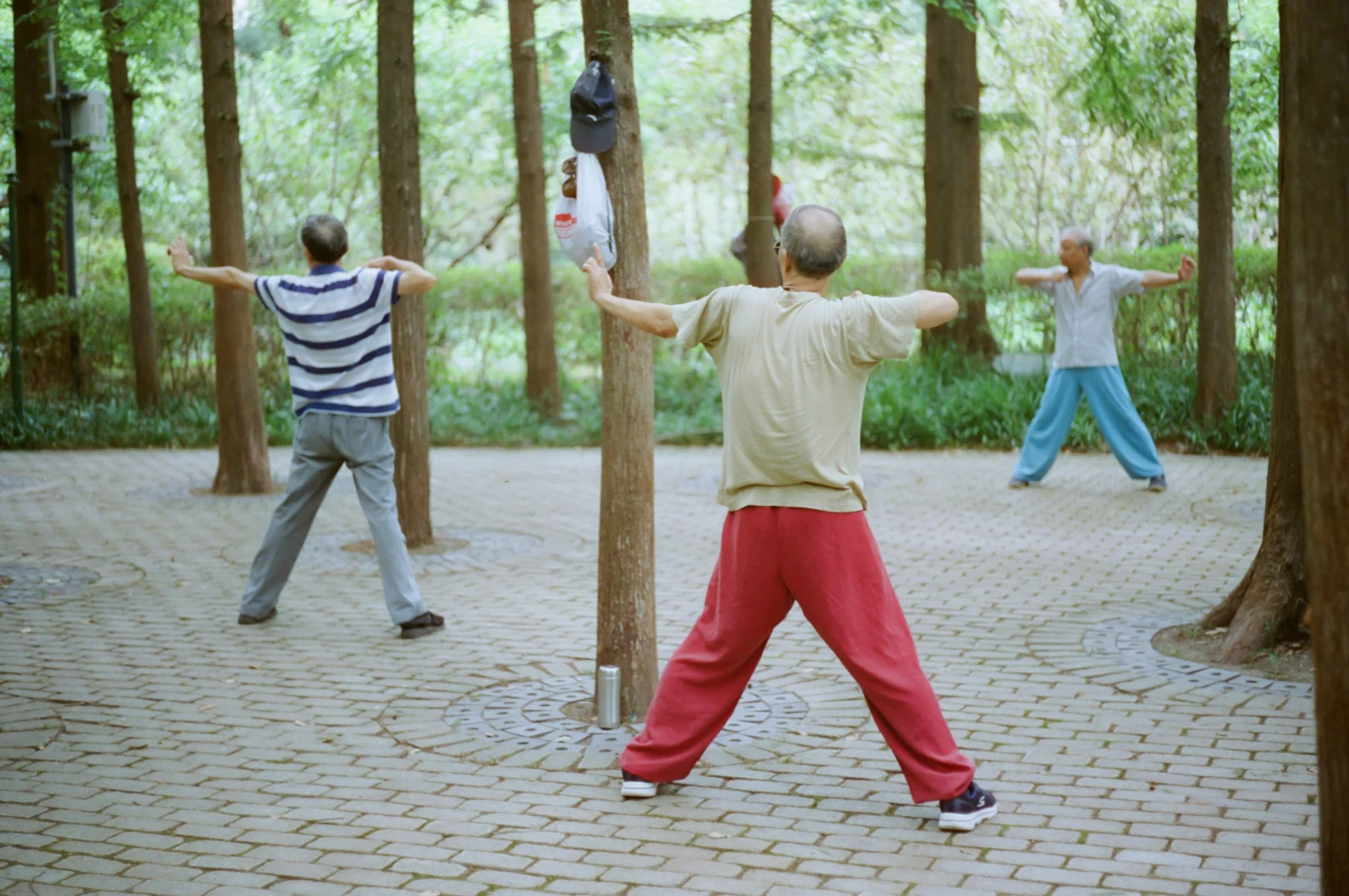
What matters more than the history when you’re starting after 50 is how tai chi feels in your body. You aren’t trying to beat a stopwatch or lift the heaviest weight. Instead, you learn to stay tall while your center of gravity moves. Your feet remain connected to the floor while your hips, knees, torso, and arms coordinate around that shifting base.
For many adults, this is an approachable doorway into active aging: not pushing harder for its own sake, but practicing movements that help you stay capable. It also illustrates how gentle exercise can challenge coordination and muscle control without relying on impact.
That makes tai chi unusually approachable for people who haven’t exercised consistently in years. “Low impact” does not mean “nothing is happening.” You’re simply creating the challenge differently.
In more than a decade of working with mind-body practices, I’ve noticed that beginners often make the same mistake during their first sessions: they watch the arms. The hands look graceful, so they assume that’s where tai chi happens. Then I have them pay attention to their feet and weight transfer instead. Suddenly, that simple movement feels completely different. The arms are what people notice; the controlled relationship between the feet, legs, posture, and center is where much of the useful work begins.
If you’re exploring other ways of adding gentle movement without gym equipment, this fits naturally alongside mind-body exercises you can do at home.
Why Slow, Controlled Movement Can Still Challenge Balance and Mobility
Here’s what nobody tells you: moving slowly can expose balance problems that momentum normally hides.
If you walk quickly through a movement, momentum can carry you from one foot to the other. Tai chi removes some of that shortcut. You deliberately shift your weight, become stable, and only then move.
That requires your nervous system to keep track of where your body is in space. Harvard Health explains that tai chi repeatedly trains weight transfer while also using leg strength, flexibility, range of motion, reflexes, and awareness of body position.
That combination matters after 50 because balance isn’t a single skill. It’s a conversation between your feet, ankles, legs, eyes, inner ear, brain, and your awareness of where your body is positioned.
This kind of deliberate practice supports everyday balance and helps develop the body awareness needed for comfortable mobility. Neither improvement happens overnight, but both can become meaningful reasons to keep practicing.
This is also why a beginner shouldn’t judge progress by whether the movements look elegant. A slightly wobbly weight shift performed with attention can be more useful than beautifully copying arm movements while your feet remain stiff.
What Are the Real Tai Chi Benefits After 50?
Balance gets most of the attention, and for good reason.
According to the National Center for Complementary and Integrative Health, a 2019 review found that tai chi may reduce the rate of falls among community-dwelling older adults by about 19% and may reduce the number of people experiencing a fall by about 20% compared with control interventions not expected to reduce falls. The certainty of evidence differed between those findings, so those numbers shouldn’t be treated as a guarantee for an individual.
More recent research points in the same general direction. A meta-analysis of 24 randomized controlled trials reported improvements in several measures of balance and a lower fall risk among older adults practicing tai chi.
That’s meaningful, but I wouldn’t reduce tai chi to “fall-prevention exercise.” For someone in their 50s or 60s, the more immediate benefit may be noticing that everyday movement feels less uncertain.
It is useful to think about fall-prevention strategies as more than avoiding a single misstep. Practicing stable turns, controlled stepping, and safe weight transfers helps build confidence; anyone experiencing repeated falls should also seek an individualized assessment.
Think about stepping off a curb, turning while carrying groceries, getting up from a low chair, or catching yourself when a foot lands awkwardly. Those tasks depend on coordinated movement, not just muscle strength.
Balance, Leg Strength, Mobility, and Confidence in Everyday Movement
A tai chi sequence repeatedly asks you to do several practical things:
Those skills connect naturally to fitness for older adults, where exercises are judged by how well they support daily activities. They can also protect independent living by making routine transitions—standing, turning, and reaching—feel more manageable.
- transfer weight without rushing;
- bend and straighten the knees within a comfortable range;
- control your trunk while your arms move;
- coordinate the right and left sides of the body;
- notice whether you’re actually stable before taking the next step.
That’s one reason I prefer thinking of tai chi as movement practice for real life, not simply a collection of poses.
A 2026 Harvard Health review notes that tai chi can support upper- and lower-body flexibility and strength while improving balance. It also explains an important mechanism: tai chi trains proprioception—the body’s ability to sense its position in space—which tends to decline with age.
For anyone particularly concerned about stability, tai chi movements for balance and fall prevention deserve focused attention rather than trying to memorize a long routine immediately.
Why Tai Chi Can Feel Calming Without Asking You to Sit Still
Not everyone relaxes well by sitting quietly.
For some people, traditional meditation creates an immediate battle with restlessness: Am I breathing correctly? Why can’t I stop thinking? How long has it been?
Tai chi gives the mind something concrete to do.
Unlike a workout that focuses exclusively on pace or repetitions, mindful, gentle movement gives you a chance to notice unnecessary tension. That quality makes tai chi practice appealing to people who want movement and attentive breathing in the same session.
You notice your feet. You coordinate an arm movement with a shift of weight. You soften unnecessary tension. You breathe while tracking the next movement. Attention gets anchored in physical sensation instead of being asked to become blank.
That is why tai chi is often grouped with mind-body practices. Harvard Health describes it as combining physical movement with mental focus, relaxation, breathing, and body awareness rather than separating exercise from attention.
If stress relief is one of your main reasons for starting, you may also find that mindfulness and meditation practices and Qigong breathing exercises complement tai chi well.
The counter-intuitive part is that your first goal shouldn’t be to feel perfectly relaxed. Trying too hard to relax can become another performance test. Learn the movement, keep the range comfortable, breathe normally, and let ease develop as familiarity grows.
What Is the Best Type of Tai Chi for Seniors?
There isn’t one universal style that automatically wins for every person over 50. Yang, Sun, and simplified forms can all be adapted, and the better question is whether the version you’re learning matches your current balance, mobility, health history, and confidence.
For most true beginners, simplicity beats tradition-for-tradition’s-sake. A shorter form with clear instruction and manageable weight shifts is usually more useful than struggling to memorize dozens of movements just because the sequence is considered more complete.
That choice becomes especially important if knee discomfort, significant balance limitations, dizziness, a recent injury, or another medical condition changes what you can safely tolerate. Tai chi is generally considered gentle, but “gentle” isn’t the same as appropriate for everyone in every form.
In Section 2, we’ll compare beginner-friendly tai chi styles, work out how often to practice, walk through the first movements step by step, and answer whether those popular 28-day tai chi workouts actually deliver what they promise.
Yang, Sun, and Simplified Tai Chi: Which Is Most Beginner-Friendly?
Once you understand why tai chi works, the next question is practical: which version should you actually learn?
The names can make tai chi sound more complicated than it needs to be. Yang and Sun are traditional styles, while many health and community programs use shortened or modified sequences drawn from traditional forms. Harvard Health makes an important point for beginners: the name of the style matters less than finding an approach that suits your needs, and shorter forms with smaller, slower movements are often recommended when you’re older or starting from a lower fitness level.
Here’s how I’d compare the most realistic choices for someone beginning after 50:
| What Matters | Simplified Beginner Form | Yang Style | Sun Style |
|---|---|---|---|
| Typical learning curve | Often 6–12 basic movements before progressing | Can range from short beginner forms to long traditional sequences | Usually flowing, compact movements; modified programs may use short sequences |
| Stance depth | Easily adjusted to comfortable knee depth | Often uses wider, sometimes deeper stances depending on teacher | Generally more upright and compact |
| Balance demand | Can start very low and increase gradually | Moderate as weight transfers become more precise | Moderate, with frequent controlled stepping |
| Best fit for a new exerciser | Strongest starting option for most people | Good if you enjoy traditional form and detailed technique | Good when mobility or joint comfort is a priority |
| Memory demand | Lower when using a short sequence | Higher with longer forms | Moderate; depends heavily on the program |
| Easy to modify | Very easy when taught for wellness | Yes, with an experienced instructor | Yes; some programs are specifically adapted for older adults |
| My usual beginner preference | First choice | Second step once fundamentals feel natural | Excellent alternative, especially in an adapted class |
For the average beginner over 50, a short, simplified form wins. You can concentrate on posture, breathing, and weight transfer instead of spending most of your mental energy wondering what movement comes next.
That doesn’t make Yang or Sun style inferior. If a skilled local instructor teaches Yang style in a patient, beginner-friendly way, I’d choose that teacher over a poorly taught “senior tai chi” program every time. And if arthritis or joint sensitivity is a major consideration, modified Sun-style programs are worth exploring; the Arthritis Foundation notes that its Tai Chi for Arthritis program uses Sun-style movements adapted for balance, relaxation, and accessibility.
The teacher and the modifications often matter more than the label.
Choosing a class that fits your starting point is central to movement after 50. For some people, low-impact exercise options provide a practical bridge from inactivity to a varied weekly routine.
How Many Times a Week Should Seniors Do Tai Chi?
A useful beginner target is two to three sessions per week, with short practice between classes if you enjoy it.
There’s no single medically mandated tai chi schedule for every healthy adult. Research programs vary widely. NCCIH reports that studies involving older adults have used schedules ranging from one to four sessions weekly, while some research showing benefits has used tai chi several times per week over multiple months.
Harvard Health’s balance guidance also notes fall-risk benefits in participants practicing three times weekly.
The mistake is assuming more is automatically better.
Twenty attentive minutes three times per week usually makes more sense for a new practitioner than forcing an hour every day until your knees ache and you quit.
Regular sessions are easier to sustain when they complement other forms of daily movement. An everyday activity such as walking can help you accumulate aerobic activity, while tai chi gives balance and controlled weight shifting more focused attention.
If you’re rebuilding an active lifestyle after a long break, the same gradual approach described in how to start exercising safely after a long break applies here too: consistency first, volume second.
A Realistic Starting Schedule When You Haven’t Exercised in a While
Try this for your first month:
Week 1: 10–15 minutes, twice during the week.
Week 2: 15 minutes, three times.
Week 3: 15–20 minutes, three times.
Week 4: 20–30 minutes, two or three times depending on how your body responds.
You don’t earn extra wellness points for practicing through pain. Mild muscular fatigue from using your legs differently can happen, but sharp joint pain, persistent dizziness, chest symptoms, or significant instability are reasons to stop and seek appropriate medical guidance.
Tai Chi Moves Step by Step for Beginners: What Should You Learn First?
Don’t begin by memorizing 20 impressive-looking movements. Build the mechanics underneath them.
- Find a comfortable upright posture. Stand tall without locking your knees. Let your shoulders drop rather than forcing them backward.
- Learn to shift weight. Slowly move more weight into one leg while keeping both feet grounded. Return to center and repeat on the other side.
- Add simple stepping. Once the supporting leg feels stable, lightly move the other foot. The goal is control, not distance.
- Let the arms follow. Add an easy pushing, opening, or cloud-like arm motion without sacrificing your balance.
- Keep breathing natural. Don’t hold your breath while concentrating. Smooth breathing matters more than perfectly matching every inhale to a movement at first.
- Repeat a few movements before adding more. Five movements practiced calmly beat 20 movements rushed from memory.
This is where daily stretching for stiffness and mobility can also complement your practice, especially if limited ankle, hip, or upper-body mobility makes certain positions uncomfortable.
Does the 28 Day Tai Chi Workout Really Work?
A 28-day tai chi workout can work as a starting structure, but the number 28 isn’t magic.
Four weeks is enough time to become familiar with basic posture, breathing, weight shifting, and a small sequence if you practice consistently. It is not enough to promise that everyone will dramatically improve balance, eliminate pain, lose weight, or “reverse aging.”
A month-long challenge is most useful when it creates momentum for an active lifestyle beyond its final day. Progress is better measured by steadier movements and a repeatable routine than by expecting dramatic results on a fixed calendar.
Most research on measurable health outcomes looks beyond a single month. For example, NCCIH describes tai chi studies lasting from several weeks to many months, with frequency and duration varying considerably.
So judge a 28-day program by a better question: Does it help you establish a practice you can continue on day 29?
That’s the outcome that matters.
What Are the Negatives of Tai Chi?
Tai chi’s safety record is reassuring, but calling it completely risk-free would be misleading.
NCCIH reports that a review of 24 studies involving 1,794 participants found similar rates of adverse events among tai chi, other active interventions, and control groups. Reported tai chi-related problems were generally minor, such as musculoskeletal aches and pains.
The more practical downsides I see are these:
- Beginners may bend the knees too deeply because they’re copying an instructor.
- Poor technique can turn “gentle exercise” into unnecessary knee or back strain.
- Long sequences can frustrate people who struggle with memory or coordination.
- Video instruction can’t physically correct your weight distribution or posture.
- Tai chi shouldn’t replace medical assessment when dizziness, repeated falls, or unexplained weakness is present.
The CDC specifically recommends discussing fall risk with a healthcare provider and identifies tai chi as an example of exercise that can strengthen the legs and improve balance.
If you have substantial balance limitations, starting beside a sturdy chair or using an adapted seated practice may be more sensible than trying to match a standing class immediately.
Tai Chi at 50, 60, and 70+: Does Your Starting Point Matter?
Your age matters less than your current function.
This is the heart of aging well: matching activity to your abilities today while keeping room for improvement. Over the longer term, consistent movement contributes to the practical goal of a longer healthspan—years lived with useful physical function.
I’ve met people in their 70s who move more comfortably than people twenty years younger. That’s why I wouldn’t prescribe a style simply because someone crossed a particular birthday.
At 50, you may primarily want mobility, stress management, and a sustainable alternative to high-impact exercise. At 60 or 70, balance confidence and maintaining independence may move higher on the priority list.
Either way, tai chi can be scaled.
Harvard’s introductory tai chi material includes both standing and seated variations, which is a useful reminder that modifying a practice is not “failing” at tai chi. Harvard Medical School’s introductory tai chi course
This broader approach fits well with low-impact exercise for adults over 60 and the idea of protecting healthspan, not simply adding years to a calendar.
Should You Learn Tai Chi at Home or Find a Tai Chi Class Near You?
For a completely new practitioner, I’d choose a good in-person class first when one is realistically available.
A qualified instructor can notice things a video cannot: your knee collapsing inward, your stance being too wide, your shoulders tightening, or your weight never fully transferring.
Home video practice still has a clear advantage: convenience.
If travel, cost, scheduling, or access makes classes difficult, a well-structured beginner video is far better than waiting indefinitely for the perfect class. Harvard Health also notes that classes provide instructor feedback and group camaraderie, while home resources can be useful for people who prefer learning independently.
The only time I’d choose video over a good local class for a true beginner is when the practical barrier to attending means the class simply won’t happen.
Frequently Asked Questions About Tai Chi for Beginners
Does the 28 day tai chi workout really work?
Short answer: yes. But here’s the nuance: 28 days works better as a habit-building period than as a guaranteed transformation program. You can absolutely learn basic movements and become more comfortable shifting your weight during four consistent weeks. Meaningful changes in balance and physical function usually deserve a longer view, so treat day 28 as a checkpoint rather than a finish line.
How many times a week should seniors do tai chi?
For many beginners, two to three practices per week is a reasonable starting rhythm. Research schedules vary, and some studies showing benefits have used tai chi three times per week. Start with sessions you can recover from comfortably, then increase duration or frequency gradually rather than changing both at once.
What is the best type of tai chi for seniors?
There isn’t one best style for everyone. For most beginners, I prefer a short, simplified form because it reduces the memory burden and lets you concentrate on balance, breathing, and posture. Sun-style adaptations may appeal to people seeking gentler, compact movements, while beginner-friendly Yang instruction can also be an excellent choice.
What are the negatives of tai chi?
Tai chi is generally considered safe, but minor muscle or joint discomfort can occur, particularly when beginners use stances that are too deep or practice too much too soon. Another limitation is instruction quality: tai chi teachers are not governed by a single national licensing standard in the United States. If you have significant health or balance concerns, look for an instructor comfortable modifying movements and coordinate with your healthcare professional.
Can you start tai chi in your 60s or 70s?
Absolutely—there’s no requirement that tai chi begin in middle age. The movements can be shortened, slowed, made more upright, or in some cases performed seated. Your current balance, mobility, and health matter more than the number on your birthday, so start with the version your body can control today and build from there.
Your Next Move: Start Smaller Than You Think
You don’t need special clothing, impressive flexibility, or a 30-movement routine.
Pick three to five basic movements. Practice for 10 or 15 minutes. Notice whether your weight is really shifting, whether you’re breathing, and whether you finish feeling steadier rather than exhausted.
Then do it again a few days later.
That’s how tai chi becomes useful for lifelong wellness—not by mastering everything quickly, but by creating a form of movement you’re still willing and able to practice years from now. If you’re building a broader routine around that idea, explore mind-body movement as part of holistic wellness or how a wellness coach can build a personalized mind-body plan.
In that sense, tai chi can be one part of a broader longevity-focused routine, alongside aerobic activity, strength training, sleep, and supportive nutrition. No single practice guarantees extra years, but building habits you enjoy can make staying active much more realistic.
If you’ve tried tai chi after 50, share what surprised you most about your first few sessions.

Certified Health Coach (CHC) and Certified Wellness Coach (CWC) through the National Wellness Institute. Tai Chi and Qigong certified facilitator with 12 years of holistic health practice and nutrition coaching.

I like how this explains that tai chi can still be a real workout even though the movements are slow. I always assumed it was mostly about relaxation 😄
Would starting with 10 or 15 minutes a day be enough for someone who hasnt exercised in a while? 🤔
The part about watching your feet instead of just your hands really stood out to me. It makes sense because the weight shift is probably where the balance work happens. 👍
Ive been doing a little tai chi at home and the slow movements are harder than they look! I especially notice it when shifting from one foot to the other. Definitely going to keep practicing 😅
The comparison between simplified, Yang, and Sun styles was really helpful. I think a shorter routine would be much less intimidating for a complete beginner. 👌
I appreciate the reminder that 28 days is more about building the habit than expecting some huge transformation. That feels much more realistic to me. 🙌
For anyone focused on balance, I think the section on tai chi movements for balance and fall prevention is worth checking out too. It gives a good idea of where to put your attention first. 🔥
I actually read a study on this from The Journals of Gerontology study on Tai Chi and falls. It looked at older adults and found that a three-times-per-week Tai Chi program was associated with fewer falls and better functional balance. I like that this article presents tai chi as something to build gradually rather than promising instant results. 😊
Can tai chi be done mostly seated if someone has trouble standing for long periods? 😮
This was a really encouraging read. I like the idea of starting with just three to five movements instead of trying to memorize a whole routine right away. Small steps seem a lot easier to stick with long term. 😍